EN


How to Plan Capacity for an Industrial DTF Printer Setup
Choosing an industrial DTF printer is not really a question of buying the fastest machine on a spec sheet. It is a capacity-planning decision: how many transfers must move through printing, powder application, curing, cutting, and heat pressing during a normal shift—and how reliably that flow must continue when orders bunch up.
As a DTF printing equipment specialist, I normally start with the workflow rather than the printhead count. That distinction matters for decorators, distributors, and growing apparel businesses. A printer that looks quick in isolation can still leave staff waiting at the shaker, oven, cutter, or heat presses. Conversely, a modest system can be the sensible choice when demand is variable and the team has not yet built a steady production rhythm.
This guide shows how to size an industrial DTF printer line around real order volume, usable throughput, media width, and downstream capacity. The goal is not to declare one universal setup; it is to help you specify a line that fits the way your business actually works.
Start With Transfer Demand, Not the Printer’s Maximum Speed
First convert incoming orders into a common production unit. For many businesses, that is square meters of printed film per day or per shift. List the average transfer size, the number of transfers per garment, and the daily order mix. Separate routine demand from promotion-driven peaks, because a system that covers an average Tuesday may not protect delivery dates during a seasonal rush.
A practical planning equation is:
Required line capacity = peak film area per shift ÷ planned productive hours ÷ target utilization.
Use productive hours rather than the full shift length. Product changeovers, nozzle checks, cleaning, loading film, color-profile verification, reprints, and operator breaks all reduce the time available for sellable output. For a new line, a conservative utilization allowance is usually more useful than assuming continuous maximum-speed production. Well, it is better to discover spare capacity on the floor than to discover an impossible queue at the end of the week.
Also keep a separate buffer for priority jobs and reprints. An industrial DTF printer should be sized for a controllable operating day, not only for the average number in a spreadsheet.
Measure the Whole DTF Line: The Slowest Station Sets Output
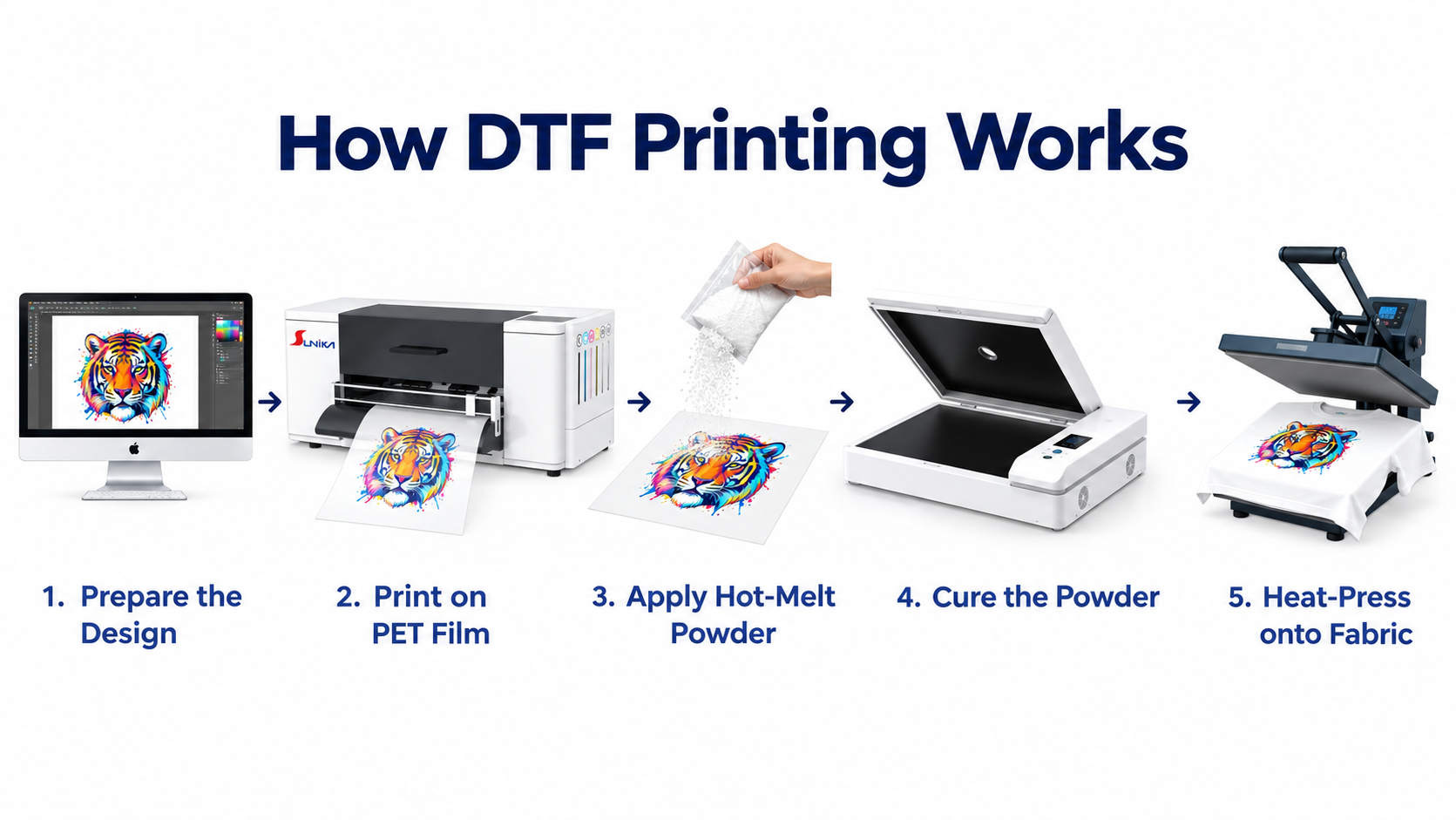
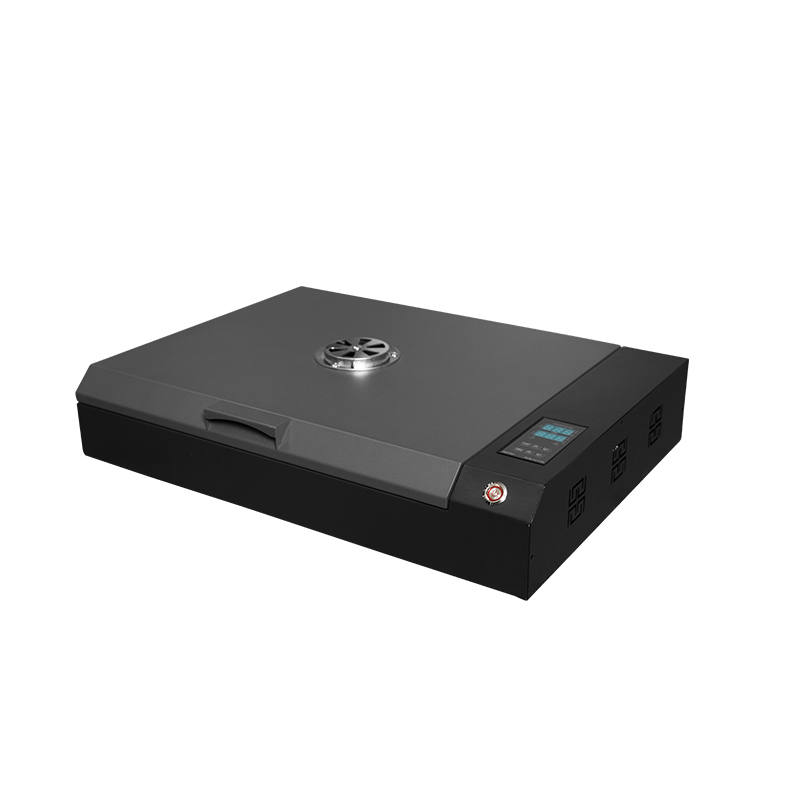
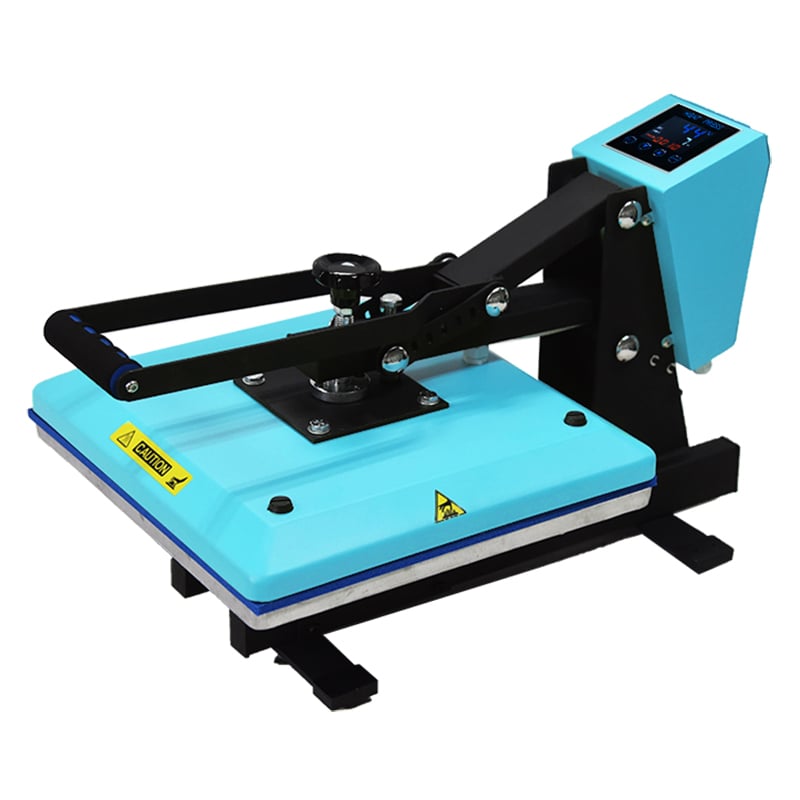
DTF production is a linked process: print the image, apply powder, cure it, manage the finished roll or sheets, cut transfers, and apply them to garments when that service is part of the order. Line capacity is determined by the lowest sustainable rate among those stages. Increasing printer output without matching powder and curing capacity simply moves the backlog downstream.
That is why the first selection conversation for a business DTF printer should include the powder shaker and dryer, take-up arrangement, roll handling, cutting method, heat-press stations, staffing, and floor layout. A continuous roll-fed workflow tends to need compatible inline finishing. An interrupted process may be appropriate for low or mixed volume, but it should be planned intentionally rather than accepted as an accidental bottleneck.
Track each station in the same unit—linear meters per hour, square meters per hour, or transfers per hour after normalizing transfer size. Then compare sustainable rates, not promotional maximums. If the printer is rated in linear meters, convert it using the actual printable width and the artwork mix you expect to run.
Choose Width and Printhead Configuration Around Order Mix
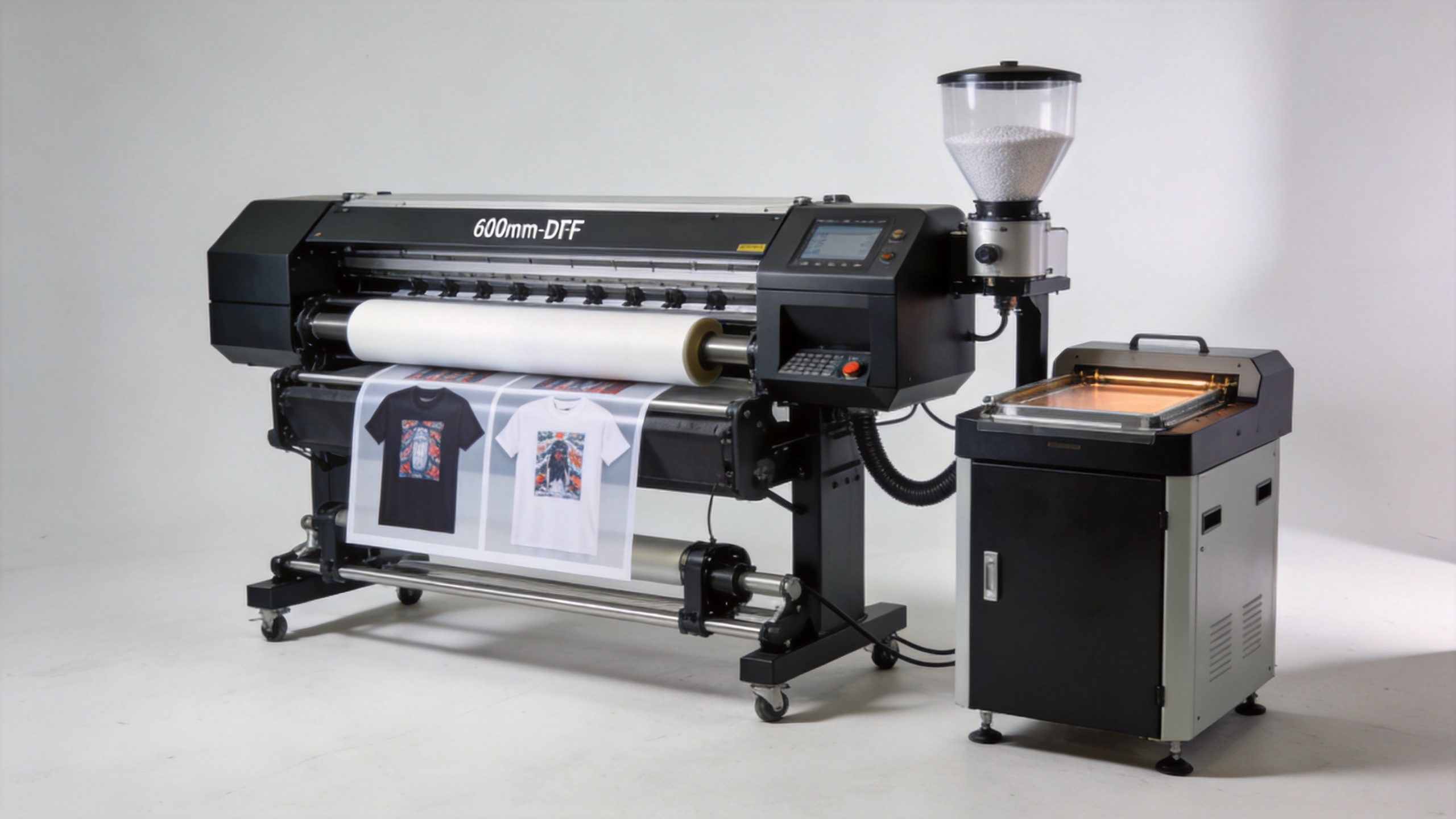
Media width changes how efficiently artwork can be nested and how much film can be processed per run. A 330 mm format can make sense for sampling, short runs, local personalization, or a business that benefits from compact equipment and frequent job changes. A 600 mm roll-fed configuration generally gives more room to gang logos, chest prints, sleeves, and larger graphics across the film, which can improve production efficiency when order flow is regular enough to keep that width utilized.
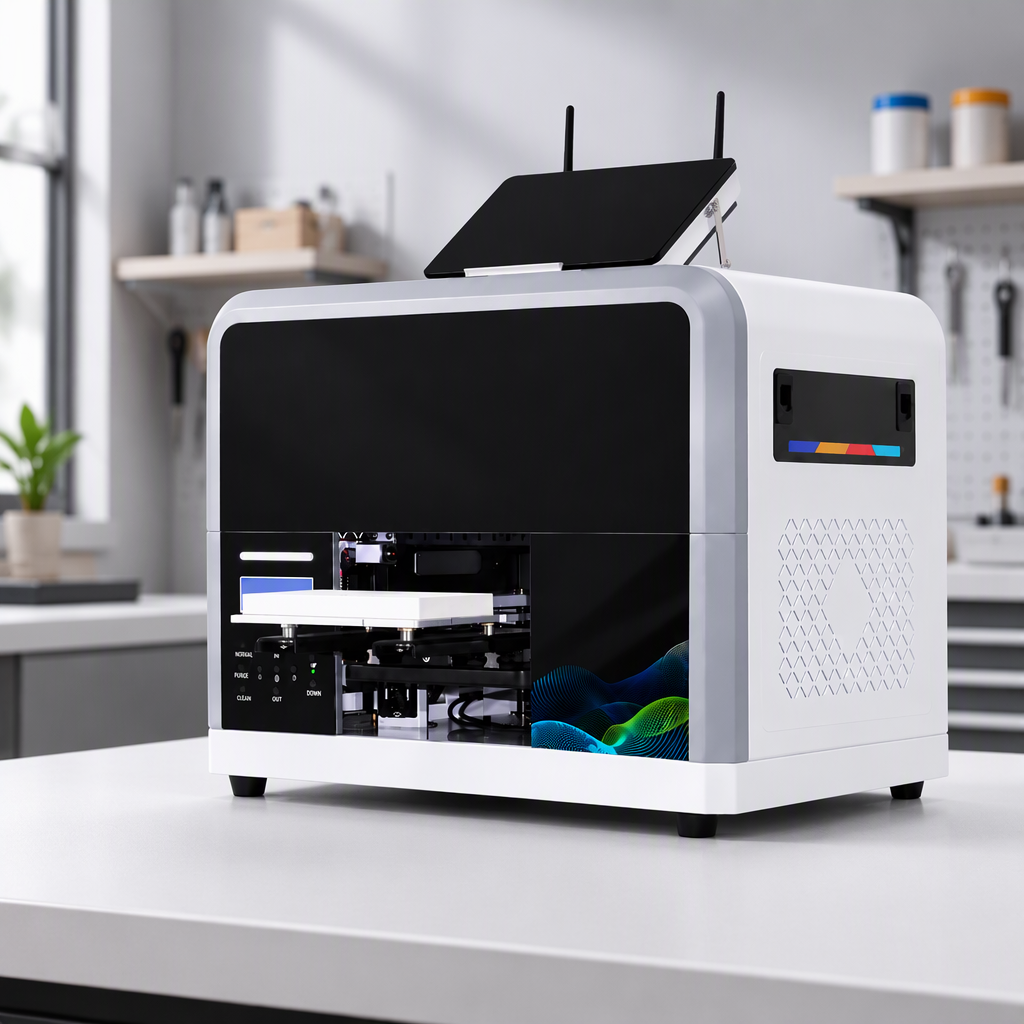
For example, Sunika SK-A3 DTF Printer F1080 330mm A3 Direct to Film Printer can be evaluated as a compact-format option, while the Sunika SK60 DTF Printer Dual I3200 600mm Tee Shirt Printer represents a wider configuration to assess for more continuous production planning. The right choice depends on job size, nesting discipline, available finishing capacity, and the downtime tolerance of the business—not width alone.
Printhead count and print mode should be treated the same way. More print capacity can help when the line has enough stable volume, trained operators, and finishing support. But if curing, cutting, or garment application is slower, adding print capacity may add work-in-process rather than completed orders. Most spec sheets will not tell you that the useful number is completed, acceptable transfers per shift.
Build a Capacity Model With Three Demand Scenarios
For an industrial DTF printer project, use the model to compare complete line configurations rather than printer-only quotes. A business DTF printer decision becomes clearer once every rate is expressed in the same unit.
Use three scenarios before committing to an industrial DTF printer setup:
- Base demand: the normal weekly order pattern, including ordinary repeat jobs.
- Peak demand: the busiest recurring period, such as event orders, back-to-school, or holiday merchandise.
- Growth demand: the next planned capacity step if dealer sales, online orders, or contract decoration volume increases.
For each scenario, calculate required film area, operating hours, expected job changes, and the capacity of every downstream station. Then ask what happens if one operator is absent, a maintenance window is needed, or a priority order arrives late in the day. That stress test is often more valuable than a headline speed comparison.
A useful rule is to avoid designing a new line so that every station is fully loaded in the peak model. Some margin helps protect color consistency, maintenance discipline, and on-time dispatch. If your priority is dependable turnaround, then continuity and bottleneck relief are the dimensions worth focusing on first.
Plan for Uptime, Consumables, and Labor as Capacity Inputs
An industrial DTF printer delivers useful capacity only when material supply, operator routines, and planned service time support repeatable output. In practice, a business DTF printer line needs a defined owner for each of those tasks.
Capacity planning is also cost planning. The purchase price felt like the main decision for many buyers, until they start tracking film handling, powder management, ink consumption, cleaning time, labor, electricity, and maintenance interruptions. The useful metric is not merely machine cost; it is controlled cost per accepted transfer at the desired service level.
Include daily and weekly maintenance in the production schedule rather than treating it as lost time. Confirm where ink, film, and powder will be stored, who owns color checks, how reprints are approved, and how finished rolls are labeled before cutting or pressing. Small control points prevent a line from producing avoidable waste at industrial volume.
For distributors and multi-site buyers, it is also worth evaluating supplier support, spare-parts planning, operator training, and the ability to standardize workflows across locations. Sunika focuses on DTF and UV printing equipment, so buyers can discuss equipment fit within a specialist product range; still, the final specification should be validated against the buyer’s own artwork, substrates, service model, and production schedule.
A Practical Configuration Checklist
Use this checklist when comparing an industrial DTF printer proposal with a business DTF printer workflow quote.
- Define peak transfer area and required delivery window, not just monthly garment count.
- Set a realistic productive-hours and utilization assumption.
- Convert printer output and finishing output into the same unit.
- Check whether powder application, curing, cutting, or heat pressing becomes the limiting station.
- Choose 330 mm or 600 mm media width based on nesting efficiency and continuous-order demand.
- Reserve room for maintenance, reprints, materials handling, and growth.
- Run representative production tests before finalizing the purchase specification.
Final Takeaway
A well-matched industrial DTF printer configuration is one whose printer, powder-and-curing stage, finishing stations, operators, and demand profile can work at a balanced sustainable rate. Start from the peak workflow, model the bottleneck, and choose width and print capacity only after the full line is visible. That approach gives a business DTF printer setup a much better chance of supporting growth without creating a new constraint somewhere else in the process.