 EN
EN


UV DTF vs DTF Printing: Which Process Fits Your Product Range?
Choosing between UV DTF and standard DTF is less about finding a universal winner and more about matching the process to what you sell. For teams researching dtf uv printing, the useful first question is simple: are your orders built around flexible textiles, rigid goods, or both? The two workflows share a transfer-film idea, but their inks, curing methods, finished feel, and application surfaces are different.
As a garment-decoration technology comparison, this guide focuses on the practical decision: which product range will each method support without forcing your operators to work around the process?
The short answer: fabric work points to DTF; hard goods point to UV DTF
Standard DTF printing produces a design on film, applies adhesive powder, cures the print, and transfers it to fabric with heat and pressure. It is commonly used for cotton, polyester, blends, and other garment-oriented substrates. UV DTF printing creates a UV-cured graphic on film that is laminated and then applied as a decal. That makes it a natural fit for many smooth hard goods, including glass, metal, acrylic, coated plastic, and similar surfaces.
That surface distinction is the foundation of a sound dtf uv printing decision. DTF is built for a flexible finished item that will be worn, folded, and washed. UV DTF is built for a surface decoration that stays on the object and gives a more tactile, often glossy label-like result. Neither description guarantees a result on every substrate: coatings, curves, texture, cleaning practices, and end use should be validated with samples.
Compare the workflows before comparing printer specifications
| Decision area | DTF | UV DTF |
|---|---|---|
| Typical output | Heat-applied garment transfer | UV-cured transfer decal |
| Primary product range | Apparel, bags, fabric accessories | Drinkware, packaging, signage, hard-surface gifts |
| Application step | Heat press | Peel-and-apply transfer process |
| Finished behavior | Needs flexibility with the textile | Surface graphic with a more rigid feel |
| Typical order logic | Textile customization and garment runs | Hard-goods personalization and branded-label runs |
In a dtf uv printing comparison, workflow is often more important than a headline speed figure. DTF requires a heat-transfer station and a repeatable process for powder, curing, and pressing. UV DTF requires disciplined film handling, lamination, and application. A shop can add both, but the extra product range only creates value when sales, storage, artwork preparation, and operator training can support both workflows.
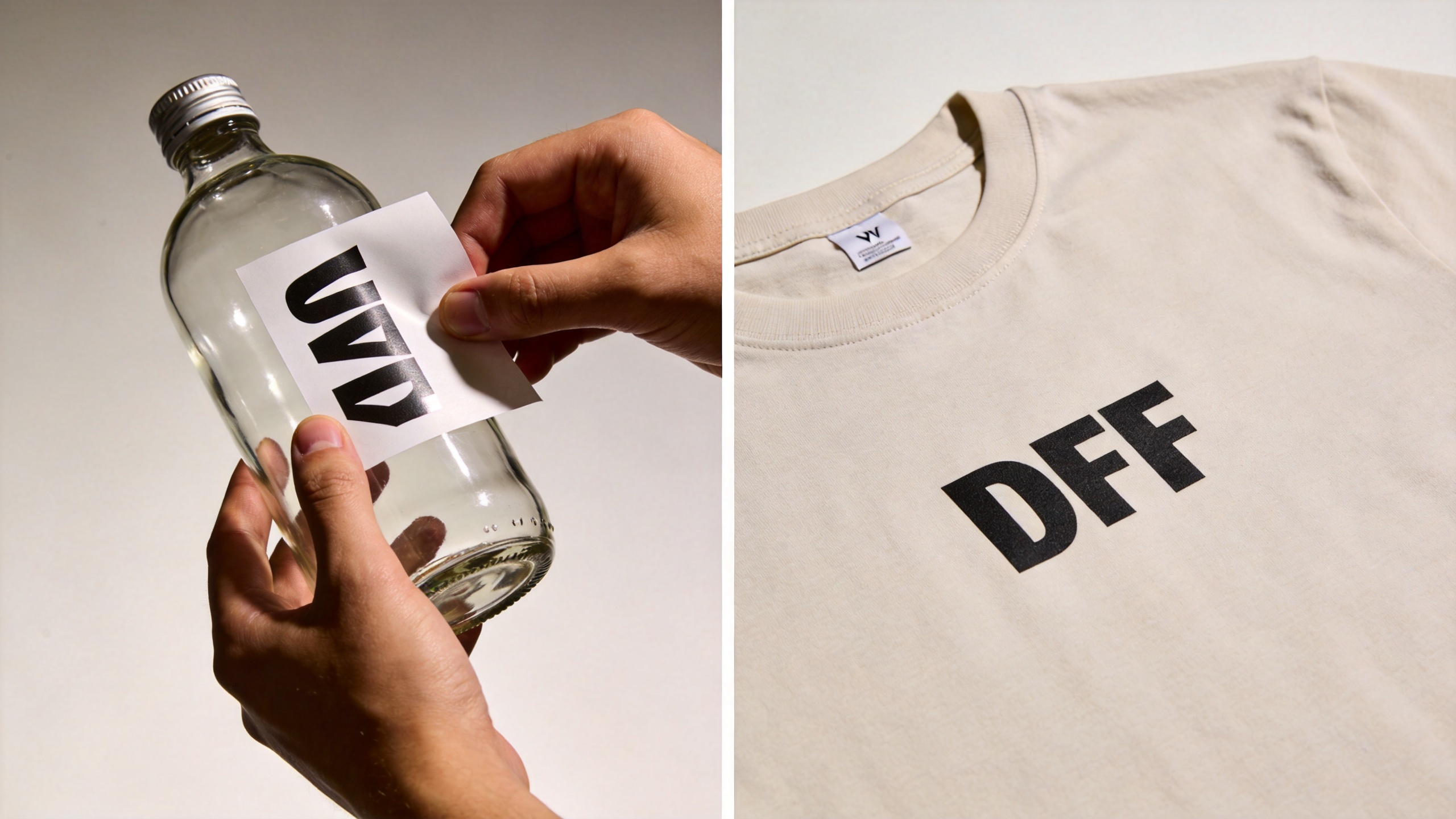
Choose by the product you need to decorate
Choose DTF when textiles drive your revenue
DTF is generally the stronger starting point when you sell T-shirts, hoodies, workwear, sportswear, tote bags, or other fabric-led products. Its value is not only substrate flexibility; it also supports short runs, variable artwork, and full-color designs without a screen setup for every design. For a shop serving apparel brands or custom-event orders, that combination can make the process easier to align with existing heat-press operations.
The important boundary is that fabric results depend on the complete system, not only the printer. Film, ink, powder, curing, press pressure, and fabric composition all affect the final transfer. A lower purchase price is not automatically a lower operating cost if reprints, cleaning, or incompatible consumables become routine.
Choose UV DTF when hard-surface decoration creates the opportunity
UV DTF is a useful route when the product mix includes bottles, jars, cosmetic containers, boxes, acrylic items, metal accessories, glassware, or promotional hard goods. The transfer approach can help decorate objects that are awkward to place directly under a flatbed printhead. For uv dtf printing, this opens a different commercial lane: branded packaging, small-batch gift products, retail labels, and personalized hard goods.
Still, UV DTF is not a blanket answer for every object. Very rough, heavily textured, highly flexible, or difficult-to-clean surfaces may require a different solution or a controlled test. The most useful dtf uv printing evaluation includes your actual substrate samples, not just a generic material list.
Finished form changes the customer promise
The customer buying a decorated hoodie usually cares about color, feel, stretch, and wash performance. The customer buying a decorated tumbler or product box is more likely to care about placement, gloss, edge appearance, and adhesion on that particular surface. This is why the same artwork may belong in two different production systems.
For dtf uv printing, separate your catalog into “wearable,” “hard-surface,” and “needs testing” groups. That simple move prevents sales teams from promising a textile-like result on a rigid object, or treating a hard-surface decal as a substitute for a flexible garment transfer.
Use order type to decide whether one process—or both—makes sense
- Mostly apparel orders: start with DTF and improve throughput, consumable control, and heat-press consistency.
- Mostly promotional items and packaging: prioritize UV DTF and build a reliable application and surface-testing process.
- Mixed personalization business: consider both only when you have recurring demand in each category, not just occasional requests.
- Dealer or distributor portfolio: position the two technologies as complementary product lines rather than interchangeable machines.
A multi-purpose plan can look efficient at first, but dedicated processes often make more sense once both garment and hard-goods orders become regular. The decision should follow order mix, operator capacity, and the surfaces you need to serve—not a claim that one technology is “better.”
A practical next step for expanding your range
If your team is building a hard-goods line alongside apparel work, begin with a substrate-and-order audit. List the items customers ask for, classify them by flexibility and surface condition, and test the highest-value samples before committing to a workflow. Businesses evaluating a UV DTF production option can review the Sunika Sk30-3 UV DTF printer as part of that broader evaluation.
A five-question dtf uv printing checklist
- What will you decorate most often? Fabric-led catalogs favor DTF; hard-goods catalogs favor UV DTF.
- How does the finished item behave? If it must bend, stretch, or be washed as apparel, evaluate DTF first. If it remains a rigid product surface, evaluate UV DTF first.
- What happens after printing? Confirm that you can run heat pressing for DTF or controlled film application for UV DTF every day, not just during a sample demonstration.
- Are orders repeatable? Recurring apparel transfers or recurring branded labels create a clearer case than isolated one-off requests.
- Have you tested the real materials? Use the exact bottles, fabrics, coatings, curves, and artwork your customers order. Surface testing is the practical safeguard in any dtf uv printing rollout.
For distributors, this checklist also makes the sales conversation more useful. Rather than leading with a machine category, ask buyers to map their current orders and the product lines they want to add next. That reveals whether they need a textile workflow, a hard-goods workflow, or a staged plan that adds the second process after demand is proven.
Common dtf uv printing decisions by product line
A dtf uv printing review becomes easier when it starts with the order rather than the machine. For a garment shop, dtf uv printing planning usually means keeping DTF at the center and adding UV DTF only when hard-goods demand is recurring. For a gift, packaging, or promotional-products supplier, dtf uv printing planning may put UV DTF first and treat textile decoration as a separate expansion path.
When comparing dtf uv printing for drinkware, test every coating and curve. When comparing dtf uv printing for apparel, test fabric composition, stretch, and pressing consistency. In either case, a dtf uv printing sample program should include the artwork sizes, colors, and handling conditions that occur in live orders.
For teams with mixed catalogs, dtf uv printing should be managed as two complementary workflows. A clear dtf uv printing production map separates film storage, artwork preparation, finishing steps, quality checks, and customer expectations. That makes dtf uv printing easier to train, quote, and scale without blurring the difference between a textile transfer and a hard-surface decal.
The bottom line on dtf uv printing is straightforward: choose DTF for fabric-centered customization, choose UV DTF for many hard-surface decoration opportunities, and use real samples to define the boundary between them. That approach gives your product range room to grow without asking one process to do a job it was not designed to handle.













