 EN
EN


What Is DTF Printing? A Beginner's Guide to Direct to Film Technology
If you are exploring custom apparel decoration, learning how to print DTF is a useful first step. DTF—short for Direct to Film—is a transfer process in which a design is printed onto a coated film, prepared with adhesive powder, cured, and then heat pressed onto the final item. For a small apparel business, it can make it easier to handle colorful, detailed designs without printing directly on every garment.
This beginner's guide explains what happens at each stage, why DTF film matters, where DTF heat transfer fits into a production workflow, and how DTF differs from DTG. The aim is not to promise a one-size-fits-all setup, but to give new buyers a clear way to evaluate the process.
What does DTF printing mean?
To print DTF means creating a transfer rather than decorating the garment inside the printer. The artwork is printed in reverse onto a specially coated PET DTF film. White ink is commonly printed as an underbase behind the color layer, then hot-melt adhesive powder is applied while the ink is still suitable for bonding. After curing, the film carries a ready-to-press design.
That separation is the main idea behind DTF. You can prepare transfers before the garment is on the press, then apply them when an order is ready. It is especially practical for custom apparel shops that handle varied artwork, small runs, or mixed garment types. Results still depend on correct ink handling, powder coverage, curing, pressing, and the compatibility of the film and textile.
How the DTF printing workflow works
A reliable print DTF workflow is a chain: every stage affects the next one. Here is the typical sequence.
- Prepare the artwork. Create a clean design with suitable resolution and set it up in RIP software for the printer and white-ink layer.
- Print onto DTF film. The printer lays down color and white ink on the coated side of the DTF film. Film orientation and ink settings should follow the material supplier's instructions.
- Apply adhesive powder. While the print is fresh, coat the printed area with hot-melt powder and remove excess powder from unprinted areas.
- Cure the powder. Heat melts the powder into an adhesive layer. Published practical guidance often places curing in the 300–325°F (149–163°C) range, but the right setting varies by powder, film, equipment, and workflow—so test rather than copying a number blindly.
- Press and peel. Position the finished transfer on the garment, apply the heat press using the transfer supplier's instructions, peel at the specified stage, and complete any recommended finishing press.
In this sequence, DTF heat transfer is the final application stage, not the whole process. The print quality may look excellent on film but still fail in production if powder is uneven, curing is incomplete, or press settings are not validated on the actual fabric.
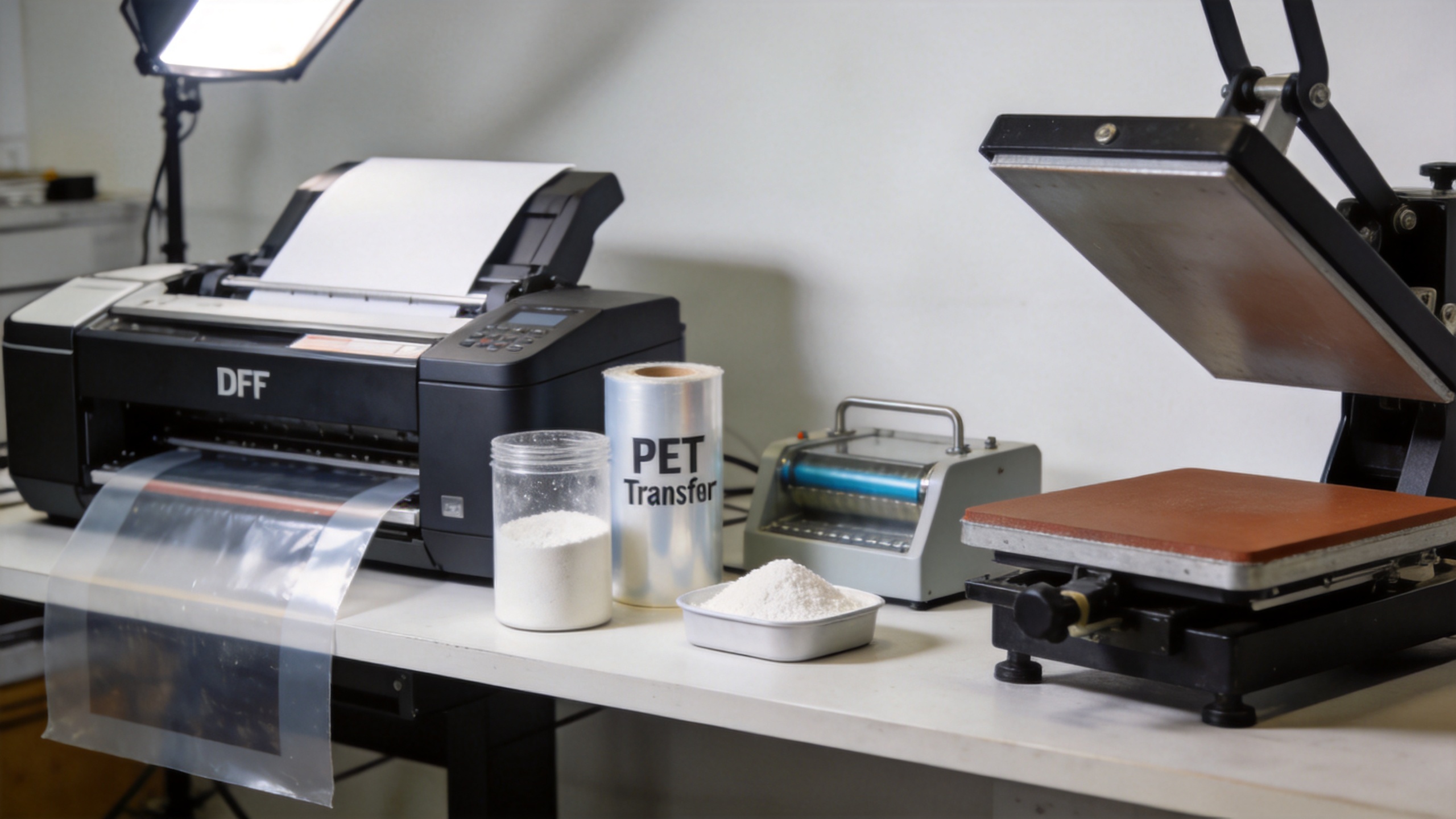
Why DTF film and powder deserve attention
Beginners often focus on the printer first, but the transfer materials are equally important. DTF film needs a coating that accepts the ink and releases correctly after pressing. The adhesive powder needs to melt consistently and bond to the intended textile. A mismatch can lead to weak adhesion, residue, dull color, or an inconsistent peel.
For a first trial, treat film, powder, ink, and curing as a tested combination. Record the material batch, artwork type, fabric, curing method, press temperature, time, pressure, and peel method. This simple log helps a small team identify whether an issue came from the print, the material, or the press step.
DTF vs. DTG: the practical difference for beginners
| Question | DTF printing | DTG printing |
|---|---|---|
| Where is the image printed? | On transfer film before application. | Directly onto the garment. |
| When is the garment needed? | At the final DTF heat transfer stage. | Before printing begins. |
| Workflow emphasis | Film, powder, curing, then pressing. | Garment preparation, direct print, then curing. |
| Good question for buyers | Can we manage transfer preparation and press quality consistently? | Can we standardize garment preparation and direct-print production? |
Neither process is automatically better. If you want to print DTF, evaluate your order mix, garment materials, workspace, finishing capacity, operator training, and the service support available for your equipment. Choose the process your team can repeat reliably.
Typical uses for DTF heat transfer
DTF is commonly considered for custom T-shirts, hoodies, workwear, tote bags, event apparel, promotional garments, and on-demand branded pieces. The appeal is the ability to prepare full-color transfers and apply them across suitable textiles when required. Before accepting a material or application as standard, run wash, stretch, and adhesion tests under your own production conditions.
For businesses comparing equipment, it helps to see how a printer fits the full workflow. For example, you can review the Sunika SK-A3 DTF Printer F1080 330mm A3 Direct to Film Printer as part of a broader film, powder, curing, and press workflow—not as a substitute for confirming material compatibility and operating requirements.
A beginner checklist before you print DTF
- Define the garment types, order sizes, and artwork styles you expect to handle.
- Confirm the complete consumable set: ink, DTF film, powder, cleaning materials, and compatible press equipment.
- Ask how white ink circulation, maintenance, and daily startup/shutdown routines are handled.
- Plan space for printing, powder application, curing, pressing, and safe material storage.
- Test representative fabrics before you quote production jobs.
- Document a repeatable DTF heat transfer recipe for each validated material combination.
Start with a controlled DTF test
The simplest way to understand how to print DTF is to run a controlled sample set: one design, one DTF film, one powder, and a few representative fabrics. Check color, fine detail, feel, adhesion, and consistency after the recommended finishing steps. Once the workflow is stable, you can expand to more artwork and garment categories with better confidence.
DTF is approachable because its stages are clear, but quality comes from managing those stages together. Begin with the workflow, validate your materials, and select equipment that matches the volume and support needs of your custom-apparel operation.












