 EN
EN


DTF Transfer Sheets vs DTF Film Rolls: Choosing the Right Format for Your Printer
Choosing between DTF transfer sheets and roll film looks simple until it affects feeding, labor, media waste, and the consistency of a busy print day. The right format is not automatically the lowest-priced box on a supplier list. It is the format that matches your printer’s feed system, usable width, order pattern, and the way your team actually works.
For a small custom-apparel shop, pre-cut dtf sheets can remove a surprising amount of setup friction. For a transfer producer running gang sheets or long production windows, roll film can make more sense. The useful question is: where does each format reduce risk in your workflow?
Start with the printer feed path—not the film price
Check the machine before comparing consumables. A sheet-fed printer needs flat media that stays flat and registers reliably. A roll-fed DTF printer needs a compatible roll width, stable edge tracking, and a take-up or downstream process that can handle continuous output. Common roll widths are often described around 30 cm and 60 cm, but usable width varies by model. Confirm the printable area in your own specification rather than assuming every “60 cm” system uses the same margin.
DTF transfer sheets are usually the easier operational fit for desktop and smaller-format equipment. They arrive cut to size, so an operator can load one job, print it, and move to the next without trimming film from a roll. That is helpful for samples, one-off logos, short runs, and shops where the same operator also answers customers, prepares artwork, and presses garments.
Roll film is built for continuity. If you print repeated gang layouts or many transfers in one session, it can reduce interruptions caused by loading individual sheets. The trade-off is that roll handling asks more of the setup: correct alignment, clean feed rollers, tension control, and a process for cutting and organizing the printed output.
Compare the workflow, not just “sheets versus rolls”
| Decision factor | DTF transfer sheets | DTF film rolls |
|---|---|---|
| Typical fit | Short runs, samples, mixed designs, sheet-fed printers | Repeat production, gang layouts, roll-fed printers |
| Setup | Lower; no roll trimming before a job | Higher; alignment and tension matter |
| Handling risk | Less risk of feeding a long run off-track | More sensitive to skew, curl, and downstream handling |
| Material planning | Easy to allocate by job or design | Efficient when layouts use width consistently |
| Scaling potential | Practical for controlled, varied workloads | Practical for longer, repeatable production windows |
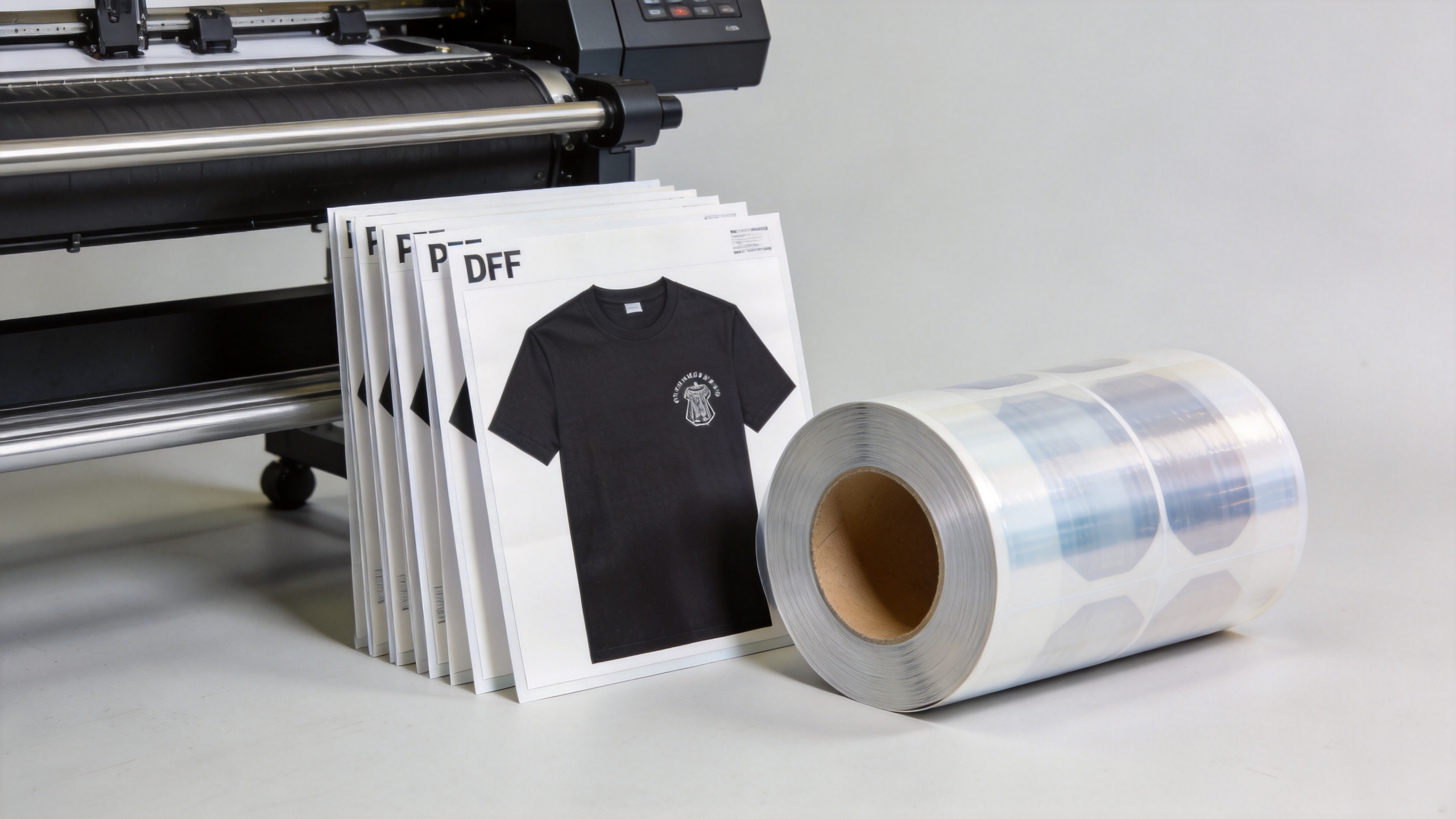
A common mistake is to buy roll film because it seems more “professional,” then use it for scattered one-sheet jobs. The result can be extra cutting, more leftover media, and more operator attention—not more throughput. Conversely, a shop producing the same sizes repeatedly may spend too much time loading individual dtf sheets when a properly configured roll workflow would be smoother.
How film gauge affects color and hand feel
Film thickness is worth checking, but it should not become a shortcut for judging transfer quality. Supplier guidance often places DTF film around 75–100 microns. A heavier film may be easier to handle in some workflows and may support a higher ink load, while a lighter film can feel easier to feed or peel in others. Neither outcome is universal.
Color density and hand feel come from the whole transfer system: ink limits, white underbase, adhesive powder, curing, press temperature and pressure, artwork coverage, fabric type, and peel timing. In other words, a thicker film does not guarantee richer color, and a thinner film does not guarantee a softer result. For transfer dtf work on dark garments, run the same artwork on your target fabric and compare opacity, edge detail, stretch, and the final feel after pressing.
That test matters especially when you change more than one variable at once. If you switch film, powder, and press settings together, it is hard to know why the result changed. Keep the ink, artwork, powder, curing routine, and press settings fixed while comparing formats or gauges.
Choose by monthly output and order pattern
Low and mixed monthly output
Choose DTF transfer sheets when jobs are small, artwork changes often, and convenience matters more than uninterrupted production. They make sense for testing new designs, fulfilling small batches, or supporting a compact setup. Pre-cut media can also simplify job handoff: each sheet can stay with its work order from print through pressing.
Growing production with repeated layouts
Consider roll film when the printer is already roll-fed and you routinely produce larger gang layouts, recurring logo programs, or batches with similar dimensions. The advantage comes from better continuity, not simply buying a longer piece of film. Plan layouts so the width is genuinely used; otherwise the apparent roll-film saving can disappear as unused side margin.
High-volume transfer production
For sustained output, look beyond format to the complete line: printer width, shaker and curing capacity, take-up method, cutting station, quality checks, and consumable replenishment. A roll is only one part of a stable production system. It is often worth asking a supplier for a configuration discussion based on actual print width, monthly square footage, and expected peak periods.
A practical qualification checklist
- Verify that the film format and width match the printer’s documented media path.
- Print the same high-coverage and fine-detail designs on your target garments.
- Check feeding consistency, curl, powder coverage, peel behavior, and edge sharpness.
- Press samples using your normal temperature, pressure, and dwell time.
- Evaluate hand feel and stretch after cooling; do not judge from the printed film alone.
- Track operator time, wasted edge material, and reprints for a complete cost comparison.
Questions buyers should ask before ordering DTF media
When comparing dtf transfer sheets, ask whether the listed size matches the printer’s supported sheet size and whether the film stays flat in your local storage conditions. For dtf sheets, ask about pack count, coating side, peel behavior, and whether the supplier recommends a specific ink or powder combination. These details can matter more than a small difference in unit price.
For roll media, ask the same questions in a different form: what roll widths are available, what core size is required, and how well does the film track on your printer? A transfer dtf workflow should be assessed from loading through cutting and pressing. If a roll needs frequent intervention, its nominal capacity does not translate into productive capacity.
Use a written test card for both formats. Record the printer setting, ink profile, film name, powder, cure setting, press setting, garment, operator, and result. That gives dtf transfer sheets a fair comparison against a roll rather than relying on memory after a single print. It also helps you spot whether a result changed because of the media or because another process variable moved.
- For dtf sheets, test first-sheet and last-sheet feeding from a new pack.
- For transfer dtf production, test a continuous run long enough to expose tracking or curl issues.
- For dtf transfer sheets, compare a fine-detail logo, a heavy white-underbase design, and a large color block.
- For dtf sheets, check how packaging protects corners, edges, and the coated face.
- For transfer dtf roll media, calculate waste from lead-in, tail, test prints, and unused width.
Keep the decision tied to the job mix. A shop that produces varied orders can value the predictable handling of dtf transfer sheets; a transfer producer with stable layouts can value a continuous transfer dtf run. Neither format is universally better. The better format is the one that gives your team repeatable results with the least avoidable handling.
Quick buyer summary
Choose dtf sheets when simple loading and flexible job changes are priorities. Choose a roll when the printer accepts it and the workload supports continuous production. Before a bulk order, qualify dtf transfer sheets or roll media with your own inks, powder, curing routine, press, and garments. This one controlled trial is the most reliable way to turn a transfer dtf specification into a practical purchasing decision.
Where to source compatible DTF film
When you need a product reference for your evaluation, review the available DTF White Ink Transfer Film Heat Transfer PET Film alongside your printer’s media requirements. Ask for confirmation on size, format, peel type, and recommended workflow before treating any film as a direct substitute for your current material.
For most buyers, the decision is straightforward once the workflow is clear: choose dtf sheets for controlled, flexible jobs and compatible sheet-fed equipment; choose rolls when a compatible roll-fed printer and repeatable production volume can make continuous media handling worthwhile. Test the full transfer, not the film in isolation, and let actual waste, labor, and finished-garment quality guide the next purchase.













