 EN
EN


DTF Printer for Small Business: How to Choose the Right Setup
Choosing a DTF printer for small business is less about finding the lowest purchase price and more about matching a complete production workflow to the orders you expect to handle. A compact machine can be a sensible first step for a custom-apparel shop, decorator, or print-on-demand startup—but only if its print width, maintenance needs, companion equipment, and supplier support fit the way you work.
For DTF printers for small business, the practical question is not simply “Which model fits?” It is “Which setup lets us produce consistent transfers without creating a bottleneck in printing, powder application, curing, or pressing?” Use the following framework to compare options before you buy.
Start With Your Real Order Pattern
Begin with the work you have now and the work you can reasonably win over the next six to twelve months. List your typical order size, the number of designs per order, turnaround expectations, and the garment types customers request. A shop producing occasional logo transfers has different needs from one handling daily multicolor shirt runs for local teams or online stores.
For a DTF printer for small business, a smaller print width may be a good fit when your runs are short, your workspace is limited, and you need flexibility rather than continuous output. A wider format can make more sense when gang sheets, repeat orders, or multiple designs are regularly waiting in the queue. The important comparison is productive output across the whole workflow—not a headline speed figure viewed in isolation.
- Low or irregular volume: prioritize manageable maintenance, a compact footprint, and a setup you can operate confidently.
- Growing daily volume: look closely at media handling, white-ink circulation, workflow capacity, and how easily the system can fit with powder and curing equipment.
- Peak-season volume: confirm how the printer, curing station, heat presses, and staff capacity will work together before assuming a larger machine solves every delay.
The purchase price may feel like the main decision at first. Once you track ink use, film, powder, cleaning time, reprints, and operator time, the more useful number is cost per usable transfer. A lower-priced machine can be the better investment when it fits your actual workload and maintenance discipline; it is not the better choice if frequent downtime prevents you from meeting committed delivery dates.
Choose Print Width and Footprint Together
Print width affects how you arrange designs on film, while the footprint affects where the entire production cell can live. Do not evaluate the printer alone. Measure room for the machine, film loading, ink handling, powder application, curing, finished-transfer staging, a heat press, ventilation, and routine cleaning access.
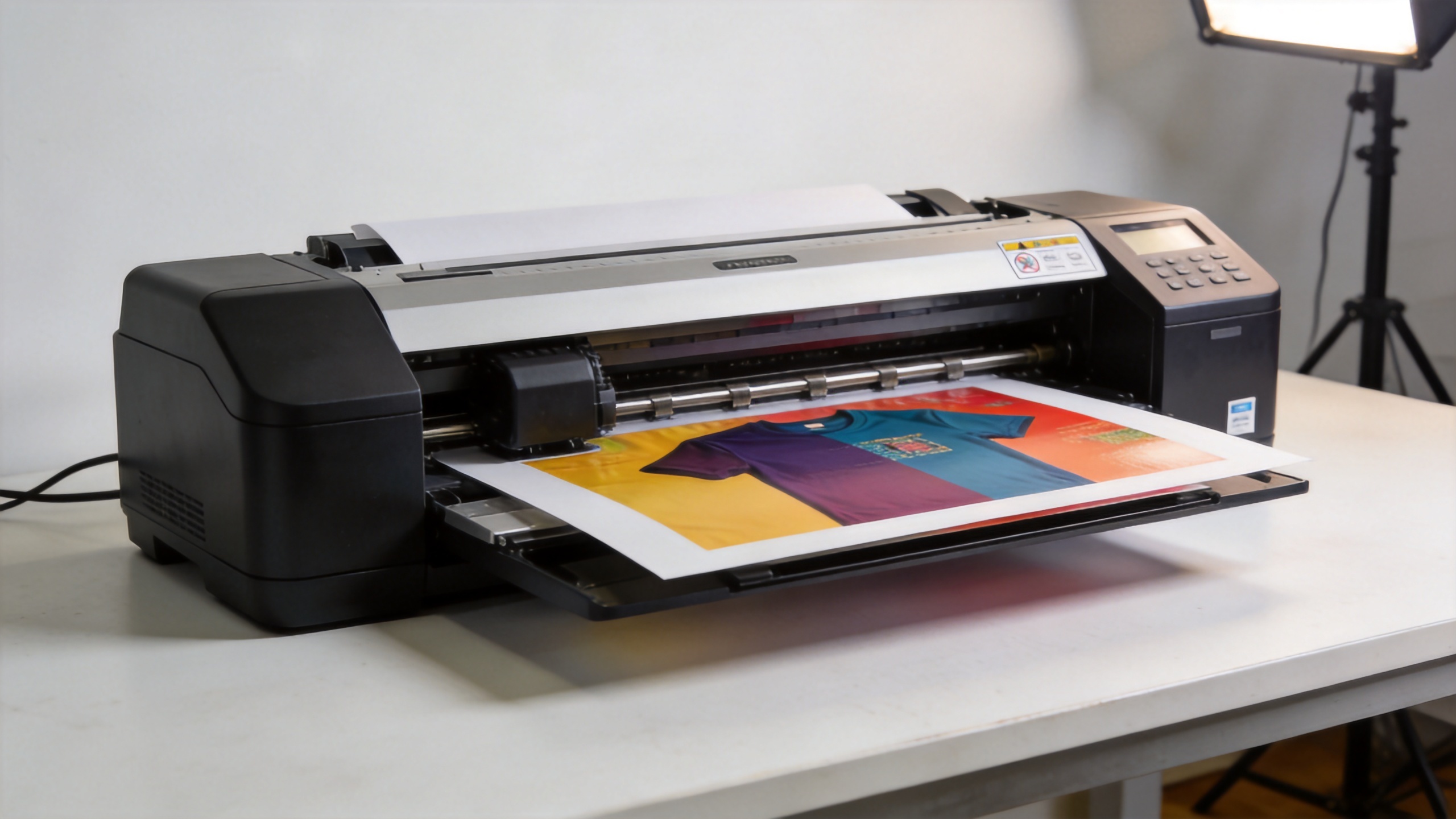
An A3-class option can be practical for a compact studio that needs an approachable DTF printer for small business workflow. For example, the Sunika SK-A3 DTF Printer F1080 330mm A3 Direct to Film Printer is a real product-page option to review when an approximately 330 mm A3 format aligns with your design sizes and available space. Review the product documentation directly for the current configuration and included items rather than assuming specifications from the model name.
Before finalizing a size, map a common day: where does printed film wait, where is powder applied, how is curing handled, and where do finished transfers go before pressing or shipping? A tidy material flow helps a small team avoid avoidable handling errors.
Budget for a DTF Setup, Not Only a Printer
DTF printing is a workflow. In a typical process, color and white ink are printed onto transfer film, adhesive powder is applied, the powder is cured, and the transfer is pressed onto the garment. That means a complete budget should include more than the printer.
| Setup area | What to evaluate | Why it matters |
|---|---|---|
| Printer and RIP workflow | Compatibility, file preparation, training, and daily checks | Consistent artwork preparation reduces reprints and operator confusion. |
| White-ink management | Circulation, agitation, cleaning routines, and idle-time procedures | White ink is central to many DTF transfers, so maintenance capability matters. |
| Powder and curing | Equipment capacity, workspace safety, and supplier-recommended settings | These stages can become the limiting factor after printing. |
| Consumables | Ink, film, powder, cleaning supplies, and spare parts availability | Ongoing supply reliability affects delivery promises and cost control. |
| Heat pressing and finishing | Press size, pressure consistency, cooling/peeling workflow, and staging | A good transfer still needs repeatable application to create a sellable garment. |
Published curing guidance often cites a range around 149–163°C (300–325°F), but the right setting depends on the powder, film, and supplier instructions. Treat any general range as a planning reference, then validate your actual materials with test transfers. This conditional approach is safer than copying a single setting into every job.
Compare Reliability by Daily Routine
Reliability is not just a brand label. For DTF printers for small business, it is the result of machine design, consumable quality, environment, cleaning habits, and the support available when something goes wrong. Ask suppliers to explain the required daily, weekly, and shutdown maintenance in plain language.
Useful questions include:
- What must the operator do before printing, during printing, and at the end of the day?
- How is white ink managed when production is intermittent?
- Which consumables and wear parts should be kept on hand?
- What diagnostic information should be shared if remote support is needed?
- What training, software guidance, and response process are available after delivery?
In practice, many issues come from a mismatch between equipment and operating conditions rather than from a single component. A supplier that can clearly explain setup, maintenance, troubleshooting, and replacement-part access may be more valuable than one that only provides a short specification sheet.
Check Material Range Against Your Sales Mix
One reason to consider a DTF printer for small business is flexibility across common decorated-apparel materials. DTF transfers can support full-color designs on light and dark garments without pretreatment in the way some alternative garment-printing workflows require. The relevant test, however, is your own product mix: cotton shirts, polyester sportswear, blends, nylon items, bags, or other materials should be sampled with your selected film, powder, ink, and press procedure.
Do not promise wash durability, adhesion, or color results until you have tested the complete material combination. Build a small sample library and record the garment, artwork, transfer settings, and result. That record becomes more useful than generic claims when customers ask what you can decorate.
Use a Supplier Evaluation Checklist
For overseas buyers, after-sales communication and technical accuracy deserve the same attention as printer features. Compare suppliers using a consistent checklist:
- Clear product configuration and a written list of included items
- Practical installation, RIP software, and workflow training resources
- Documented maintenance schedule and troubleshooting path
- Availability of inks, films, powder, cleaning supplies, and spare parts
- Response expectations for remote technical questions across time zones
- Sample-output and material-testing guidance relevant to your market
Specialized DTF and UV equipment suppliers may offer more focused product knowledge and after-sales support than general-purpose printer resellers, but you should still verify the current support scope and service terms before purchase.
Make the Decision With a Pilot Plan
The most suitable DTF printer for small business is the one that matches your current order profile, leaves room for controlled growth, and comes with a workflow your team can maintain. Compare two or three shortlisted setups using the same criteria: daily order capacity, footprint, companion equipment, consumable availability, maintenance time, training, and support.
Then run a pilot plan. Select several representative designs and garment types, calculate the workflow from file preparation through pressing, and document where time or quality problems appear. This approach gives a small business a clearer basis for choosing between a compact starter setup and a larger production-oriented system—without relying on price alone.













