 EN
EN


Best Heat Press Machines for DTF Transfers: Types, Settings and Top Picks
Choosing a heat press for DTF transfers is not just a question of buying the largest platen or the lowest-priced machine. For a print shop, distributor, or growing apparel decorator, the press determines whether transfer application is repeatable across a full day of production. A dependable DTF press delivers stable heat, even pressure, and a workflow that matches the garments and output volume you actually handle.
This guide compares the main press styles, explains practical starting settings, and gives a buying framework for small, mid-volume, and higher-throughput DTF operations. The aim is to help buyers make a considered equipment choice—not to claim that one specification fits every film, fabric, or production floor.
What a DTF Press Must Do Well
A DTF transfer relies on the combined effect of temperature, dwell time, and pressure. If one variable drifts, the result may be incomplete adhesion, a visible press mark, or inconsistent color and hand feel. That is why a proper heat press for DTF transfers should be evaluated for more than its maximum temperature display.
- Platen consistency: The usable area should heat evenly so a gang sheet receives similar conditions edge to edge.
- Pressure repeatability: The mechanism should let an operator return to the same practical pressure without guessing on every garment.
- Clear loading access: The operator needs enough room to position garments and transfers without touching a hot upper platen.
- Workflow fit: Opening style, platen size, and cycle speed matter more as the number of daily transfers grows.
For most film and fabric combinations, supplier instructions remain the authority. A commonly used starting window for a dtf press is roughly 300–325°F (about 150–163°C), medium-to-firm pressure, and 10–15 seconds. Treat that as a test-press baseline, then adjust for the film, adhesive, garment blend, and peel method rather than applying it blindly.
Compare the Three Main Types of Heat Press for DTF Transfers
Flat clamshell presses: practical for standard apparel work
A flat clamshell press opens upward and keeps the platen footprint compact. It is often the first serious heat press for DTF because it suits T-shirts, sweatshirts, tote bags, and many flat textile applications. The straightforward motion can make it efficient for repeat jobs when the operator has a clear loading routine.
Choose this format when space is limited and most work is standard apparel. Check how far the upper platen opens, how easily pressure is adjusted, and whether the lower platen size matches your most common gang-sheet dimensions. A larger surface is useful only if the machine can keep heat and pressure consistent across it.
Swing-away presses: better access for positioning and thicker items
With a swing-away design, the heated platen moves away from the lower platen. That open workspace can make transfer alignment easier and reduce the chance of working too close to a hot surface. It is a sensible option for decorators handling thicker garments, layered placements, or varied item shapes alongside standard DTF work.
The tradeoff is footprint and movement clearance. A swing-away dtf press needs room for the arm to travel, so buyers should plan bench depth and operator space before ordering. In a low-to-mid-volume shop, the added access can be worth the slower motion; in a tightly timed line, the extra movement may not be ideal.
Automatic-open presses: designed for repeatable, higher-volume cycles
An automatic-open press releases at the end of the programmed dwell time. This does not replace operator checks, but it can reduce missed timing when one person manages several tasks. For higher-volume DTF production, the benefit is workflow consistency: the operator can prepare the next garment while the press completes a cycle.
Prioritize automatic-opening equipment when production depends on repeat cycles, shift handoffs, or multiple operators. Review the timer controls, actual opening behavior, platen temperature recovery, and service support—not just the automation label. A reliable automatic-open heat press for DTF transfers should make the process easier to standardize.
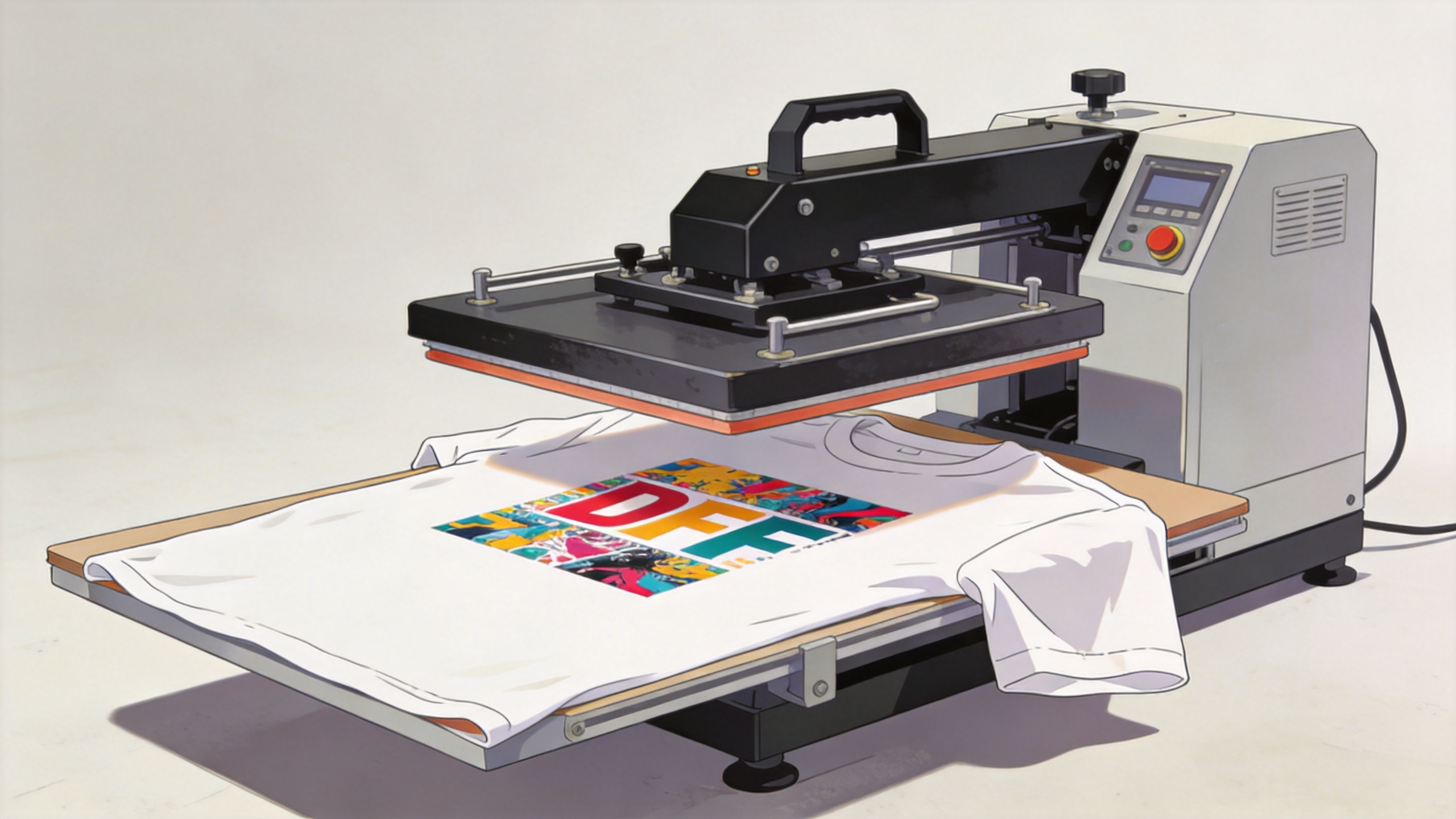
DTF Heat Press Settings: Use a Baseline, Then Test
Settings are a process, not a universal recipe. Begin with the film supplier’s instructions. If a controlled starting point is needed, many DTF workflows begin around 300–325°F, 10–15 seconds, and medium-to-firm pressure. Polyester or heat-sensitive performance fabric may require a lower temperature, while heavier textiles may need a carefully tested adjustment in dwell time.
| Variable | Typical starting point | What to verify during testing |
|---|---|---|
| Temperature | 300–325°F / 150–163°C | Actual platen temperature, fabric sensitivity, and film instructions |
| Time | 10–15 seconds | Adhesive bonding without overexposure or color distortion |
| Pressure | Medium to firm | Even contact across the design with no unnecessary garment impression |
| Peel and finishing | Follow film guidance | Whether the film is hot, warm, or cold peel and whether a finishing press is recommended |
Before applying a production run, pre-press the garment briefly to reduce moisture and smooth the application area. Then test a representative design on the actual garment. Inspect the edges after peeling and after a gentle stretch. If adhesion is uneven, first confirm platen temperature and pressure distribution; do not immediately push every setting higher.
Choose Capacity by Your Production Stage
Startup or occasional custom orders
A well-built flat press with a usable apparel-sized platen is often enough. Focus on temperature accuracy, a stable pressure mechanism, and basic controls that are easy to repeat. Avoid paying for a large-format machine if most orders are chest logos and small runs.
Growing shop with daily mixed orders
Look for a more robust frame, larger working area, and either improved access or automatic opening. Mixed garment sizes and frequent design changes make ergonomics important. A swing-away or automatic-open heat press for DTF transfers can reduce bottlenecks when operators need to align transfers accurately and keep cycles moving.
High-throughput production or dealer supply
At this stage, consistency and serviceability become procurement priorities. Compare cycle recovery, pressure repeatability, spare-parts support, power requirements, and how the press fits alongside curing, sorting, and packing stations. Buying two coordinated presses can sometimes provide more operational resilience than relying on one oversized unit.
A Buyer Checklist Before You Commit
- Match platen size to your common artwork and garment sizes.
- Ask how temperature accuracy and evenness are validated in real operating conditions.
- Confirm how pressure is adjusted and repeated between operators.
- Measure workspace for clamshell opening or swing-away clearance.
- Review timer behavior, automatic-open operation, and safety features.
- Verify electrical requirements, warranty terms, training, and access to service parts.
- Run sample transfers on representative cotton, blends, and heat-sensitive fabrics before scaling production.
For buyers seeking a flat-format option to evaluate, Sunika lists the Sunika High-Pressure Flat Heat Press Machine For DTF Printer. Review the current product page and confirm the specifications, local power configuration, and transfer workflow with the supplier before purchasing.
Final Takeaway
The right heat press for DTF transfers is the one that delivers stable, repeatable contact for your real workload. Flat clamshell machines suit many apparel workflows; swing-away models improve access for varied placement; and automatic-open presses help standardize repeated cycles. Start with film-specific instructions, establish a tested temperature-time-pressure baseline, and select the press around output volume, operator workflow, and service support. That approach gives a DTF operation a better chance of producing consistent transfers as order volume increases.













