 EN
EN


A3 DTF Printer vs 600mm DTF Printer: Which Fits Your Order Volume?
Choosing a DTF printer by print width alone is an easy way to buy either too much machine or too little production capacity. For apparel decorators, transfer sellers, and distributors, the more useful question is what your orders look like during a normal week: Are you producing samples and short runs, or are you repeatedly filling gang sheets for steady fulfillment?
An A3-format unit and a 600mm (24-inch) platform can both produce DTF transfers. The difference is how each one fits into the whole workflow: artwork layout, film handling, powder and curing, operator time, available floor space, and the cost of idle capacity. This comparison helps you select a DTF printer based on order rhythm instead of a single speed number.
Start With the Work You Need to Put Through the DTF Printer
An A3-class DTF printer generally offers a usable width around 330mm, while a 600mm platform provides roughly 24 inches of film width. That extra width matters most when several designs can be nested on one roll or when larger graphics must move through the same production flow. It does not automatically mean that every shop needs a 600mm system.
A practical way to sort your orders is by rhythm rather than a vague label such as “small” or “large”:
- Samples, personalization, and irregular short runs: an A3 setup usually keeps the workflow approachable and limits unused capacity.
- Repeat orders with several designs per batch: compare how often you can build efficient gang sheets; this is where 600mm width begins to create a meaningful workflow advantage.
- Consistent daily transfer fulfillment: assess the printer together with powder application, curing, storage, and staffing. The print stage is only one part of throughput.
Most spec sheets will not tell you this: a faster print stage does not solve a bottleneck at powder curing, cutting, quality inspection, or order sorting. A dtf printing machine should be matched to the slowest repeatable part of your process, not only its headline output.
A3 DTF Printer: A Focused Fit for Flexible, Lower-Volume Work
An A3 DTF printer is often a sensible starting point when order volume is variable, floor space is tight, or the business is validating designs before committing to a bigger production line. Its compact format makes it easier to place near a heat press and organize around short-turn custom work.
This format can be especially practical when a shop needs to print a few transfers, test color and film settings, then switch artwork without carrying a wide roll through the entire line. For an example of the format, the Sunika SK-A3 DTF Printer F1080 330mm A3 Direct to Film Printer is an A3-format option to evaluate within that kind of workflow.
The trade-off is planning efficiency. When repeat orders build up, smaller sheets can require more changeovers, more handling, and more attention to job sequencing. An A3 unit can still be the right answer for growing shops, but it is worth tracking when staff begin spending more time loading, trimming, and regrouping work than producing transfers.
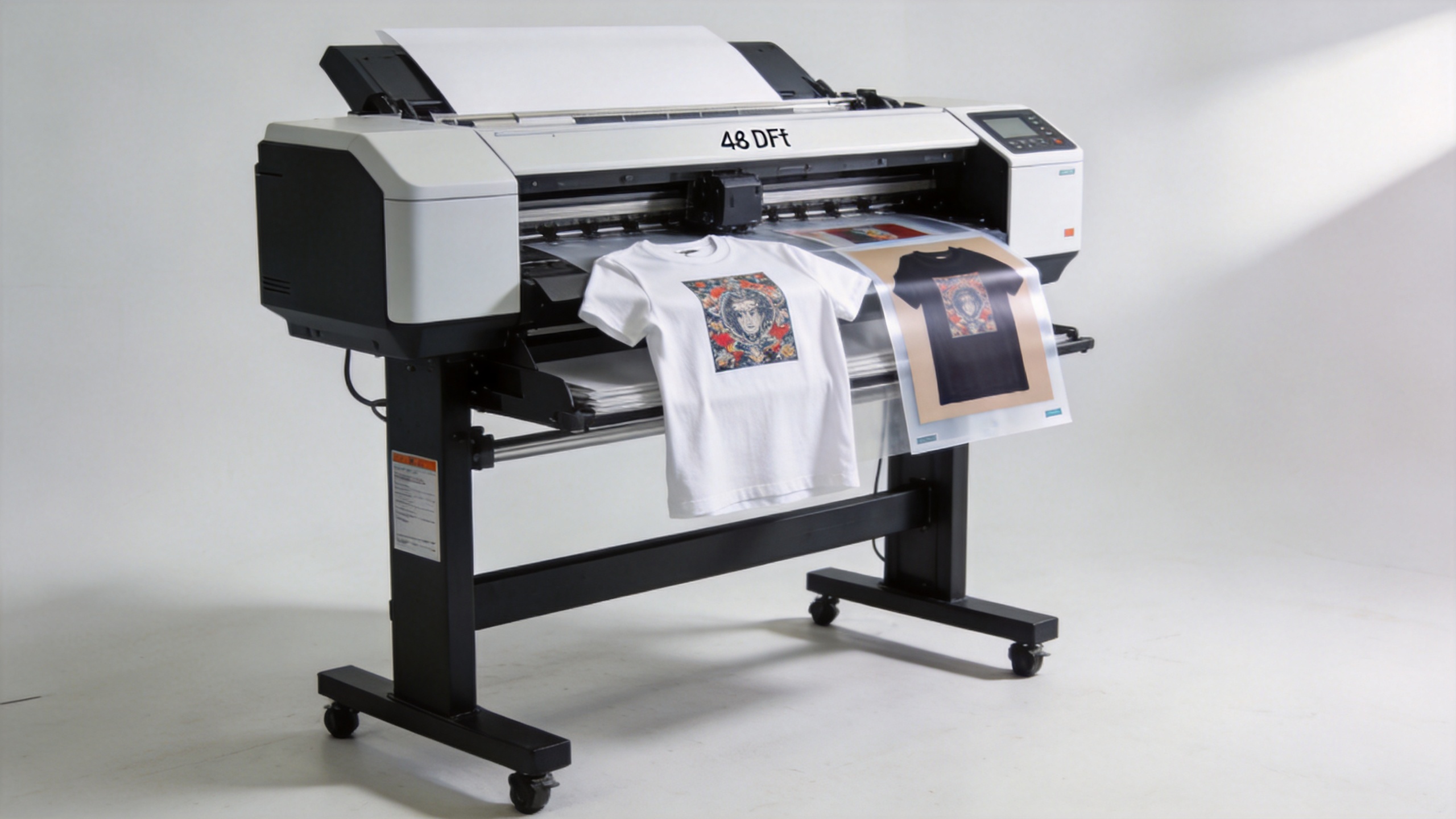
600mm DTF Printer: Capacity for Gang Sheets and Steadier Production
A 600mm DTF printer changes the operating model because wider film gives the team more room to nest designs and run larger batches. That is useful for businesses with repeat apparel graphics, wholesale transfers, or an order book that stays full enough to justify longer production runs.
The benefit is not simply “bigger is better.” A wider dtf printing machine asks for a wider supporting workflow: more working room, a reliable film path, enough curing capacity, and a process for handling output before it becomes a pile of mixed jobs. If your orders arrive in spikes rather than a stable stream, those operational demands can outweigh the extra width.
Think about the full line before stepping up. The printer, powder shaker or application process, curing equipment, ventilation plan, consumables, and finishing area should be sized as a system. Buying a 600mm platform while keeping every downstream step sized for A3 work can simply move the queue from the printer to the next station.
Compare the Two Formats Across the Decisions That Affect Daily Output
| Decision factor | A3 DTF printer | 600mm DTF printer |
|---|---|---|
| Suitable order pattern | Samples, personalization, shorter and irregular runs | Repeat batches, wholesale transfer work, sustained gang-sheet production |
| Film width | About 330mm class | About 600mm / 24-inch class |
| Floor-space demand | More compact workflow | Requires room for wider media and supporting equipment |
| Artwork planning | Simple job-by-job layout | More benefit from disciplined gang-sheet nesting and job grouping |
| Operational complexity | Lower for a small team learning the process | Higher; needs repeatable handoffs through finishing and fulfillment |
| Expansion logic | Good when proving demand or preserving flexibility | Good when consistent volume already exposes A3 handling limits |
Use this table as a discussion tool, not as a fixed threshold chart. A shop with a small footprint but highly repeatable orders may outgrow A3 faster than a larger shop with unpredictable custom work. Conversely, a 600mm system can be underused when jobs are too scattered to make efficient use of the width.
Production Rhythm Matters More Than a Single Speed Claim
When buyers compare a DTF printer, the instinct is to ask for a maximum print-speed figure. That figure matters, but throughput depends on several linked decisions. A reasonable planning exercise is to review a week of actual orders and note the number of designs, average transfer size, repeat quantities, peak days, and the time needed for curing and packing.
- Measure batchability. Can your typical orders be grouped into gang sheets without delaying urgent jobs?
- Map the handoffs. Identify who loads film, manages powder and curing, checks transfers, and sorts orders.
- Check peak-day capacity. Choose for the workload you need to repeat reliably, not an exceptional one-off rush.
- Protect working space. Wider equipment needs clear paths for media, finished transfers, and routine maintenance.
- Plan consumables and service. A larger system should have a corresponding routine for ink, film, cleaning, and operator checks.
It is a small distinction, but it changes purchasing decisions: speed describes one machine stage; throughput describes what leaves the shop ready to ship. For many businesses, the better DTF printer is the one whose output can be cured, inspected, and packed without creating a daily backlog.
When Should You Move From A3 to 600mm?
Consider a 600mm platform when repeat orders consistently make A3 film handling feel like the limiting step, when gang-sheet layouts are regularly constrained by width, and when you have the people and space to support a more continuous line. The decision is stronger when the new width will be used across normal production weeks—not only during occasional seasonal peaks.
Stay with an A3 DTF printer when flexibility, compact operation, and lower operational complexity are more valuable than continuous wide-format capacity. This is often the more disciplined choice for new transfer businesses, decorators serving varied custom work, and teams still refining their workflow.
Neither format is an automatic winner. An A3 dtf printing machine can be a productive business tool when its format fits the job mix. A 600mm system becomes compelling when consistent order volume, gang-sheet planning, and the supporting finishing process are ready to use its width.
Final Selection Checklist
- Choose A3 if your work is mainly samples, custom pieces, variable short runs, or space-sensitive production.
- Prioritize 600mm if repeat batch orders regularly reward wider gang sheets and your downstream finishing capacity can keep pace.
- Evaluate a DTF printer as a full workflow, including curing, handling, inspection, and packing.
- Ask suppliers about the format, workflow support, and setup requirements that match your actual order profile.
For buyers comparing equipment, the right DTF printer is the one that gives your team enough capacity for normal demand while preserving a process you can run consistently. Start with your order data, then choose the format that removes the real bottleneck.













